Email API for your own SMTP server.
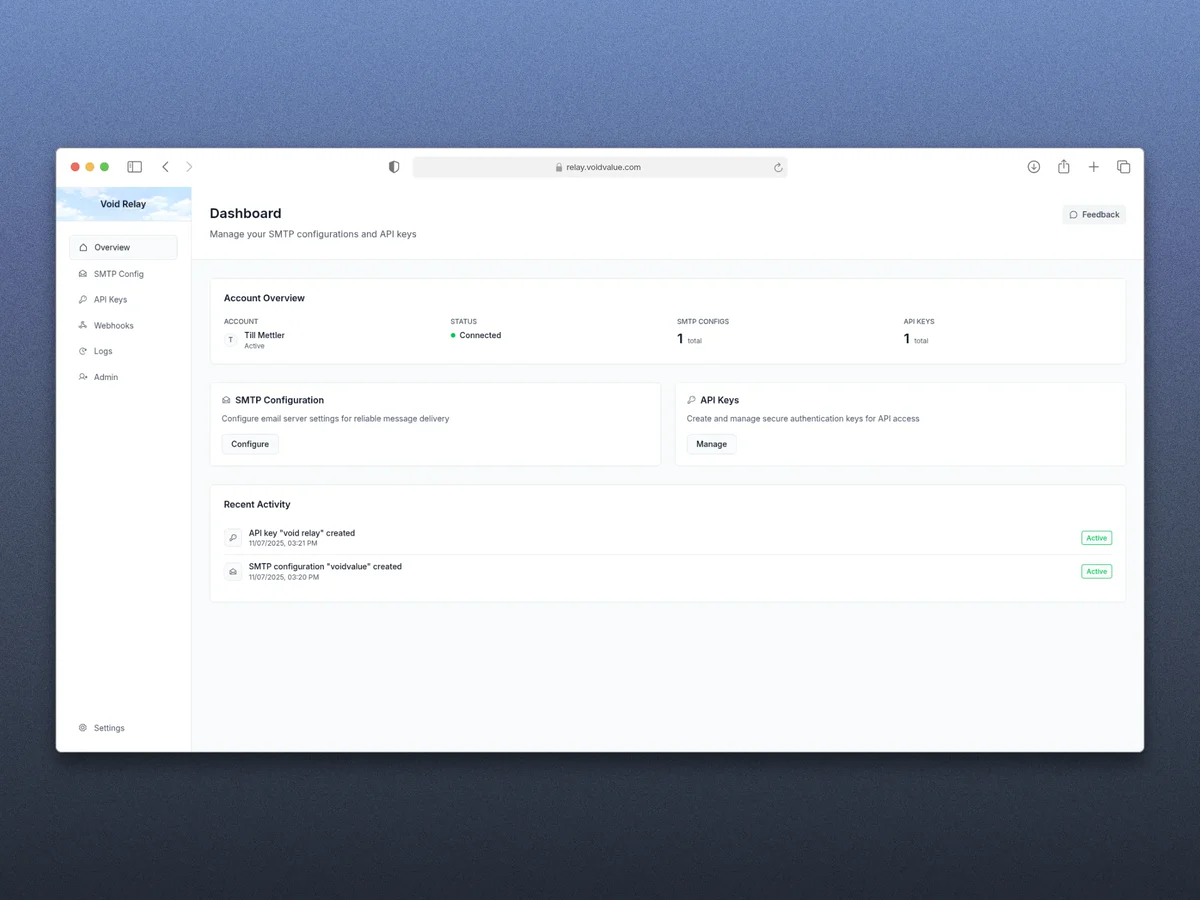
Developer-friendly REST API with webhooks and tracking. Use Gmail, SendGrid, Mailgun, AWS SES, or any SMTP provider. No vendor lock-in.
Beta Launch: Join now and get 5,000 emails/day per API key forever
Features
No Vendor Lock-in
Bring your own SMTP infrastructure. Unlike Resend or SendGrid, you control your email provider. Use Gmail, SendGrid, Mailgun, AWS SES, or any SMTP server.
Developer-Friendly API
Simple REST API similar to Resend. Send emails with a single HTTP request. Integrate with any programming language or framework in minutes.
Real-time Webhooks
Get instant delivery notifications. Track opens, clicks, bounces, and delivery events with webhook callbacks—just like the big providers.
Powerful Analytics
Monitor email delivery in real-time. View detailed logs, debug failed deliveries, and track email performance with comprehensive analytics.
Get notified for every email event
Configure webhooks to receive real-time notifications when emails are sent, delivered, or fail. Integrate with any service.
- Email sent notifications
- Delivery status updates
- Failure and error alerts
- Configure multiple webhook URLs
The fastest possible email delivery.
Our API runs on a global network. Requests are executed closest to your SMTP server or where they're made, ensuring the fastest possible experience.
Edge Computing
API requests are processed at the edge, closest to your SMTP server location. This minimizes latency and ensures the fastest email delivery possible.
Worldwide Availability
Deployed globally to ensure low latency regardless of where you or your SMTP provider are located. Your emails reach inboxes faster.
Use your favorite programming language
Our REST API works with any language. TypeScript/JavaScript SDK available now, with Python, Go, Ruby, and PHP coming soon.
TypeScript/JavaScript
npm package
Official SDK with full type safety and zero dependencies
Python
pip package
Python SDK with type hints and async support
Go
go module
Lightweight Go module with full error handling
REST API
Any language
Works with cURL, PHP, Ruby, Java, C#, and any HTTP client
View code examples in JavaScript, Python, Go, and cURL in our documentation
View DocumentationSimple, transparent pricing
Start for free, scale as you grow. No hidden fees, no surprises.
Free
- 2,500 emails/day per API key (5 API keys = 12,500/day total)
- Unlimited SMTP servers
- Full REST API access
- Customizable webhooks
- Email tracking & analytics
- Global edge network
Pro
- Everything in Free, plus:
- 20 API keys (vs. 5 in Free)
- Priority support
- Advanced analytics dashboard
- Team collaboration
- Pre access to new features
- 99.9% SLA guarantee
All plans include your own SMTP infrastructure. No vendor lock-in, ever.
Beta users keep 5,000 emails/day per API key forever
Ready to start?
Join our beta and get 5,000 emails per day per API key. No credit card required.
Frequently Asked Questions
Everything you need to know about Void Relay
What is Void Relay?
Void Relay is a developer-friendly email API that works with your own SMTP infrastructure. Think of it as Resend or SendGrid, but you bring your own SMTP server—no vendor lock-in, full control over your email delivery.
How is Void Relay different from Resend, SendGrid, or Mailgun?
Unlike Resend, SendGrid, or Mailgun, Void Relay does not host your emails. You bring your own SMTP server (Gmail, AWS SES, your own server, etc.), which means no vendor lock-in, lower costs, and full control. We provide the REST API, webhooks, and tracking—you provide the SMTP infrastructure.
Can I use my own SMTP server?
Yes! That's the core feature of Void Relay. You can use any SMTP provider: Gmail, SendGrid, Mailgun, AWS SES, Postmark, or your own self-hosted SMTP server. You have complete freedom and no vendor lock-in.
Does Void Relay support webhooks and email tracking?
Yes, Void Relay provides real-time webhooks for delivery notifications, email tracking, and bounce handling—just like Resend or SendGrid, but with your own infrastructure.
How do I integrate Void Relay into my application?
Void Relay provides a simple REST API similar to Resend. You can integrate it with any programming language or framework in minutes. Just configure your SMTP server, create an API key, and start sending emails through our API.
What's included in the free plan?
During our beta phase, the free plan includes 5,000 emails per day per API key (5 API keys = 25,000 emails/day total), unlimited SMTP servers, full REST API access, customizable webhooks, email tracking & analytics, and global edge network. No credit card required.
Does Void Relay have a TypeScript/JavaScript SDK?
Yes! Void Relay offers an official TypeScript/JavaScript SDK available on npm (@voidvalue/relay). The SDK provides full type safety, automatic email validation, and zero
dependencies. SDKs for Python, Go, and other languages are coming soon.
What programming languages does Void Relay support?
Void Relay's REST API works with any programming language (JavaScript, TypeScript, Python, Go, PHP, Ruby, Java, C#, etc.). We currently offer an official TypeScript/JavaScript SDK, with Python and Go SDKs coming soon. You can use the REST API directly with any HTTP client in the meantime.
Is Void Relay open source?
Not yet! Void Relay is still in development. It will become an open-source project once all the planned features have been implemented.